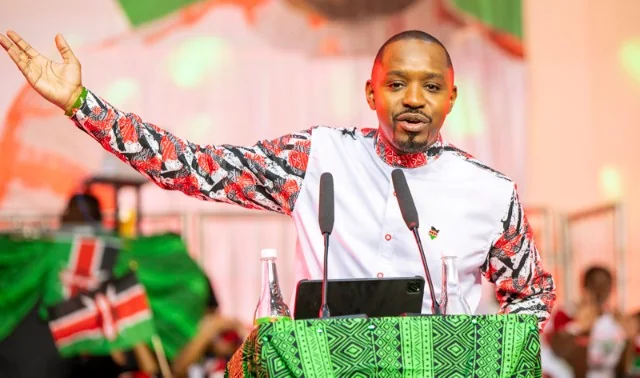
Ukweli Party leader and presidential aspirant Boniface Mwangi has challenged President William Ruto to disclose the ownership and financing of SIBOH School and Sports Academy following its launch at the President’s Koilel farm in Eldoret.
Mwangi has raised questions about the institution’s ownership structure, construction contractors and whether public resources were used to establish or support the private school.
The concerns follow the launch of the institution by First Lady Rachel Ruto on Wednesday, November 18, 2026. The school combines academic education with sports training and is expected to admit its first learners in January 2027.
ALSO READ
In a statement on Thursday, Mwangi asked the President to disclose the individuals or entities that legally own the school and the people serving on its board.
"Who legally owns SIBOH School and Sports Academy, and who sits on its board?" Mwangi posed.
He also demanded details of the companies contracted to construct the institution, questioning whether any of them have existing government contracts.
The presidential aspirant further sought clarification on whether public money, land or state-funded infrastructure, including roads, electricity and water connections, contributed to the school's establishment or operations.
Mwangi also questioned how the President would separate any private interests connected to the institution from his public responsibilities, particularly in setting education policy, allocating public funds and regulating private schools.
"When the person who holds the purse for public schools has a private school built on his own farm, Kenyans are entitled to ask whose interests are being served," he said.
The Ukweli Party leader also criticised the institution's fee structure, which he said ranges from KSh90,000 to KSh370,000 per term, depending on the learner's level.
The published fee schedule confirms that charges vary from KSh90,000 for playgroup to KSh370,000 for Grade 12, with additional costs applying to some services and requirements.
At the highest fee level, Mwangi argued, annual school fees would exceed KSh1.1 million, excluding other charges such as registration, transport and medical expenses.
He compared the fees with the government's annual parental contribution guideline of KSh53,554 for public boarding schools, arguing that the institution would be beyond the reach of many Kenyan families.
“One year of fees for a child at SIBOH could pay public boarding school fees for twenty children,” he said.
Mwangi linked the school launch to wider concerns over the financing of public education, citing proposed increases in secondary school fees of up to KSh43,000 and concerns raised by the Kenya Secondary Schools Heads Association over inadequate and delayed government capitation.
He also cited a capitation shortfall of more than KSh40 billion for secondary and junior secondary schools, arguing that public institutions were struggling with mounting debts and inadequate resources to sustain learning programmes.
The presidential aspirant called on President Ruto to publicly declare his net worth and provide details of the school's ownership and financing.
“I have publicly declared my own net worth. I invite the President to do the same, and to publish the full ownership and financing of this school,” Mwangi said.
He argued that the country should prioritise adequate funding, staffing and equipping of public schools.
SIBOH School and Sports Academy is preparing to offer education from pre-primary to senior school while incorporating specialised sports training. Its first intake is scheduled for January 2027.
Mwangi's questions place the institution's ownership, financing and possible use of public resources at the centre of a growing public debate following its launch.